Arjo Klamer addresses the question of “how can we bridge the gap between economics and culture?”
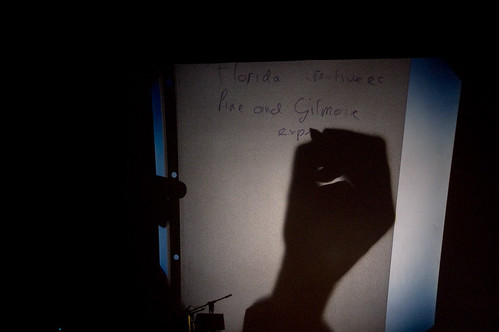
Klamer gave up on PowerPoint a long time ago because the flip-over has several advantages over Powerpoint: You can keep referring to it and you can draw and add notes while you are speaking to clarify things. This makes it a superior technique that is very effective. Presenters often read off the PowerPoint which not only makes it a very boring presentation but it also makes people feel stupid because they can read themselves. Klamer gives us a live demonstration of the advantages of another “old forgotten” presentation technique: the overhead projector. This old presentation technique immediately causes some problems because the right sheets and pens are initially lost.
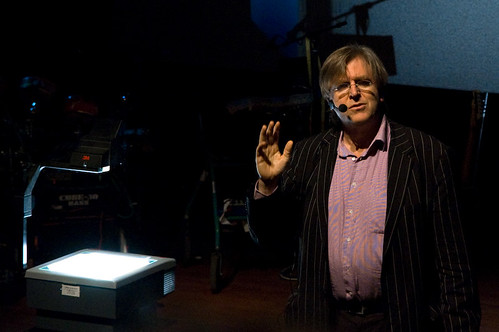
Arjo Klamer is professor of the Economics of Art and Culture at Erasmus University in Rotterdam, The Netherlands, and holds the world’s only chair in the field of cultural economics (from klamer.nl). This chair has changed dramatically over the years as there used to be an enormous gap between economics and culture. Economics was a suspicious subject especially when you were critical of government subsidies. Nowadays more and more people in the world of the arts have adopted the language of economists but Klamer thinks this adoptation has gone too far. We are now thinking too much in economic terms. If you deal with cultural goods, goods with a symbolic value, then the market is not the most appropriate space to realize them.
The connection between economics and culture is now understood by politicians, both left-wing and right-wing who have discovered the power of culture. This insight is completely new but has a lot of consequences. Richard Florida explored this shift in “The Rise of the Creative Class” where he describes the role of the creative class in the urban regeneration. Florida places creativity in the center of the new economy. We no longer live in an information economy but in a creative economy. (The guy who is setting next to me writes down “NO MORE FLORIDA!” but unfortunately I never find out why.)
We are currently very worried that outsourcing our labor processes to China will influence our economy but we must keep in mind that the actual production is only a fraction of the cost. What we really pay for is the idea, the image and the symbolic value. We pay for the experience and the the symbolic value that is attached to it.
Klamer explores the great divide between economics and culture. How do we transfer the creativity to the business world? Not only are the values different, the rhetoric and the way people talk are also different. How to we translate the rhetoric and bridge the gap? The problem is that we place the logic of the government against the logic of the market with its demand and result-oriented approach.
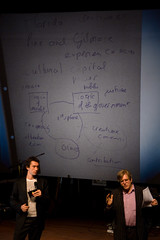 We need a third sphere where art gets realized which Klamer refers to as “the oikos” (Greek for: fireplace, the law of the household). This sphere has its own logic which we take into other spheres. This third sphere is a social space that might be a critical sphere. The third sphere, the creative commons, requires and depends on contributions. The logic of the third sphere is the logic of reciprocity. Another name for this sphere is the creative commons in which we can also place the web, open-source software and its community. Klamer states the Internet arose in the logic of the creative commons.
This is where I disagree with Arjo Klamer.
In my view the Internet arose in the logic of the government because the ARPANET was developed by the United States Department of Defense. The ARPANET, as predecessor of the Internet, was developed in close connection with researchers at universities but all the terminals were sponsored by ARPA. In the late eighties the Internet shifted from the logic of the government to the logic of the market when the first Internet Service providers were formed. (History of the Internet).
The Internet is not as open and democratic as is presented by Klamer. Alexander Galloway described in ‘Protocol’ how the Internet is both radically distributed and highly controlled. According to Klamer we can take the logic of the third sphere into the other spheres. Has the web shifted from the logic of the government to the logic of the market to the logic of the oikos? If we choose to place the web within the logic of the oikos than we must keep in mind that it is still tightly bound to the logic of the market. The Internet still resides in all the spheres with their own logic. We must not place things in a linear way but rather use Foucault’s concept of genealogy.
Arjo Klamer is currently involved in setting up a university in the third sphere. The Academia Vitae is an institution that reflects on the divide between economics and culture. It also acts on the divide with firms that pay for the student’s Master degree. It uses the logic of the third sphere where the reciprocity is that students have a (paid) graduation project and firms receive projects. There is a focus on how the students can use their creativity without losing their own integrity. In order to stay in the third sphere you need to retain your own authenticity and integrity without going into the spectacle.
Yes, the original networks of the Internet and the idea of a World Wide Web may have been government-based. Furthermore, governments regulated those fat “pipes” that could handle the heavy data that now course through them.
And yes, spectrum became furiously marketable in the 90’s when cable and telephone companies, with their already-established worldwide networks, realized the spectacular potential of the Internet and accompanying value of high-speed connectivity.
But it is the people, the commons, the allure of free speech and expression that gave rise to and have given shape and form and content to the entity we know as the Internet. It is far less market- and government-controlled than our radio and television networks. Indeed, it’s the largest collective, ongoing, creative expression of the common people the world has ever known.
You are absolutely right. My main problem with Klamer’s argument was that he did not mention (or know) the history of the Internet in relation to the logic of the government/market.
Indeed the Internet is now more located in the commons but the logic and the influence of the market is still playing a huge role. Save the Internet is the prime example of an initiative that is fighting the influence of the market on the Internet. It tries to keep the Internet in the realm of the commons while the market is trying to pull it out of that realm.
Thanks for the report. I especially like the mentioning of the technique of presenting as it points to the merits of old techniques and the limitations of the new ones.
One correction: the third sphere is a derivative of the oikos (the home) and refers to all social interactions that, I think, generate most important values, the values that matter such as cultural values.
As to the web discussion, I agree with the criticism, but am pleased with the response of Susan MacDonald. I was evoking the notion of the creative commons with as the main point that in that commons values are being realized in ways that are distinct from the logics of the market and the government sphere.